 19:04
19:04 20:11
20:11 SUKKOT, primo giorno - Lev. 22-26/23-44, Num. 29-12/29-16


As Adei, we have participated with deep conviction in this initiative—the remembrance of Giuliana Fiorentino Tedeschi on April 14, 2026—on a particularly significant day for the entire Jewish world, Yom ha Shoah. Giuliana Tedeschi was, above all, an extraordinarily strong woman, a shining example of dignity and civil resistance for all of us. Her strength lay not only in surviving the hell of the extermination camps, but also in her ability to return and share her experiences. Participating in this remembrance means celebrating a woman who transformed horror into a lesson for new generations.
Each of us represents a special moment in Giuliana Tedeschi’s life, and my personal contribution to this evening in her memory is linked to her work in the school environment.
In 2018, on the occasion of the 80th anniversary of the racist laws, the “Domenico Berti” High School undertook research in its archives to verify the possible presence of Jewish students and teachers at the school during those years and to organize an exhibition. On that occasion, Giuliana’s personal file was found in the school’s current archive. To make this document public, permission was sought from the family, and in particular from her daughter Rossella, who generously allowed her mother’s story to become a shared heritage. It was moving for me and my students to read the file because in just a few lines it recounts a terrible time.
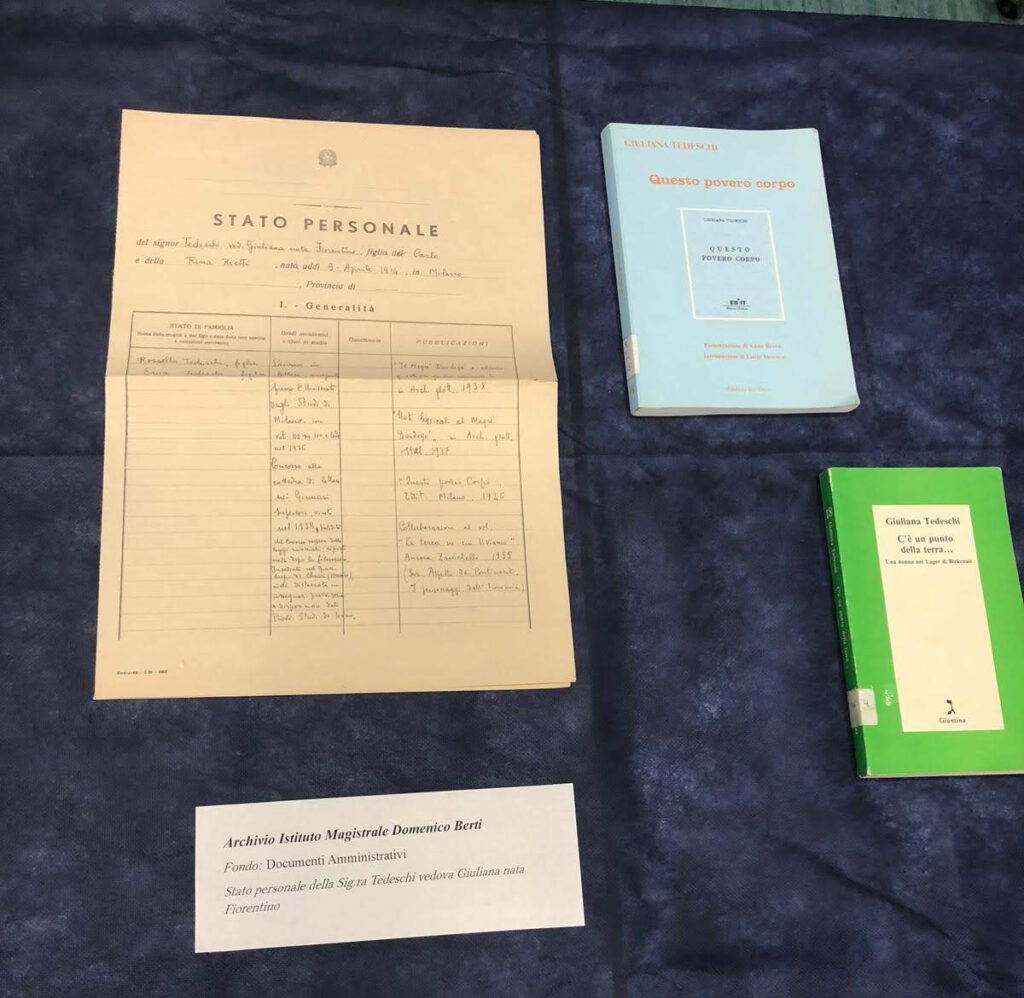
The personal file
The document is organized according to a rigid ministerial grid, divided into thematic columns that trace the employee’s life with a bureaucratic coldness that still leaves one shocked today.
- The Family Status: In the left column, the names of the daughters, Rossella and Erica, appear. This is a striking detail: the document, updated post-Liberation, mentions the girls who were separated from their mothers during the years of deportation, reminding us of the human and private dimension of the trauma.
- Qualifications and service record: Degree in Literature from the Faculty of Literature of the University of Milan in 1936 with honors and publication honors under Benvenuto Terracini. Qualified to teach Literature, Latin, and Greek in the 1937 competitive exam. Winner of the competition for the chair of Literature at the upper secondary schools, tenured in 1938.
Historical note: It states that she was “exempted from service” under the 1938 racial laws, only to be reinstated retroactively after the war. This “normal” language, inserted among the merits as if it were a negative qualification, certifies the transformation of a brilliant young teacher into a citizen without rights.
However, the file also recounts an incredible recovery. Next to the phrase “Economic Effective Date 1945,” we can imagine the reality of a young mother returning from the extermination camps in the summer of 1945 after more than a year of captivity, devastated and a widow, struggling to reconnect with her two daughters whom she had not seen for so long.
Yet, already in the 1945-46 school year, she was teaching. She didn’t wait for the trauma to heal; she chose school as a place of healing. The technical term “Riedita” (reinstated) marks her physical return. (Only in 1947 did the State formally recognize the “legal effect from 1938”: a bureaucratic attempt to fill the temporal gap of the persecution, trying to “repair” his career as if those years had never been interrupted).
- Publications
The publications column accurately documents Giuliana’s transition from brilliant scholar to indispensable witness. We can read the evolution of her work there:
1937-1938 Early Works: Before the Racial Laws Giuliana is a promising scholar. She publishes “Moth – l’esercito al Magù” (1937) and “Il ninfèo – Dialoghi e visioni” (1938) with the Gastone publishing house. These texts demonstrate her humanistic education and her collaboration with the Archive of Glottology. The school textbook “Il Regno d’Israele” also dates back to this period.
1946 “Questo povero corpo”
While Giuliana was reunited with her family and teaching, her book, “Questo povero corpo,” was published shortly after her return in 1946. This text is not just a memoir, but an act of civil courage. At a time when society sought to suppress horror, Giuliana chose to document the unspeakable with a specifically feminine sensibility. Along with very few other authors, and even fewer of them women, Giuliana felt the urge to write about her experience immediately, before her memory was filtered by time. The book analyzes the Nazis’ destruction of female identity and describes the concentration camp not only as a place of extermination, but as a place of desecration of the female body, transforming her suffering into a universal denunciation of the violation of human dignity.
1955 Teaching Commitment: In the following years, her work continued to be intertwined with teaching, as demonstrated by her collaboration on the volume “The Land We Live In” (1955), a sign of her full reintegration into the school community. During these years, Giuliana taught at various institutions, but our file ends in 1955, the year in which she held a teaching post at Berti.
Curriculum
1945-1947: Liceo Cavour.
1947-1948: Liceo Alfieri.
1948-1955: Istituto Magistrale Regina Margherita.
1955-1956: Scuola Magistrale Domenico Berti.
1956-1972: Liceo Classico Vincenzo Gioberti (where she remained for most of his teaching career).
1973-76: Headmaster of the Jewish School of Turin, where she brings her strong human energy and a touch of innovation and professional rigor.
Written in 1964 but published only in 1988, another seminal book, “C’è un punto della terra… Una donna nel Lager di Birkenau” was published.
At the same time, she continued her tireless and crucial work as a witness in schools.
As I personally observed, as a teacher, when I heard her speak to students, Giuliana never sugarcoated reality and always spoke in a language appropriate to their age. In this sense, it is very interesting to revisit the film/interview filmed by Daniele Segre at the Jewish School in 1998, with the middle school students and their absolute concentration. Her narrative was starkly realist, uncompromising yet always free of violence, aimed at denouncing the violation of privacy, the loss of femininity, and the torment of wounded motherhood.
Giuliana Tedeschi taught us that one can return from hell and sit back behind a desk to educate for the future. His archive file, with its handwritten notes and posthumous repairs, is in some ways proof of this.
By Eva Vitali Norsa

