19:04
19:04 20:11
20:11 SUKKOT, primo giorno - Lev. 22-26/23-44, Num. 29-12/29-16


While April 25th is the official date chosen throughout Italy to celebrate Liberation from Nazism, and the Jewish community was unable to participate (due to its coincidence with Shabbat), the date of the 26th is also significant for the city of Turin, marking the beginning of the insurrection in the city (the coded order, “Aldo says 26×1,” is well known). Therefore, as President Dario Disegni rightly stated, while the Jewish community was unable to officially participate in either the torchlight procession on the evening of April 24th or the celebrations on the 25th, the date of the 26th is not without significance.
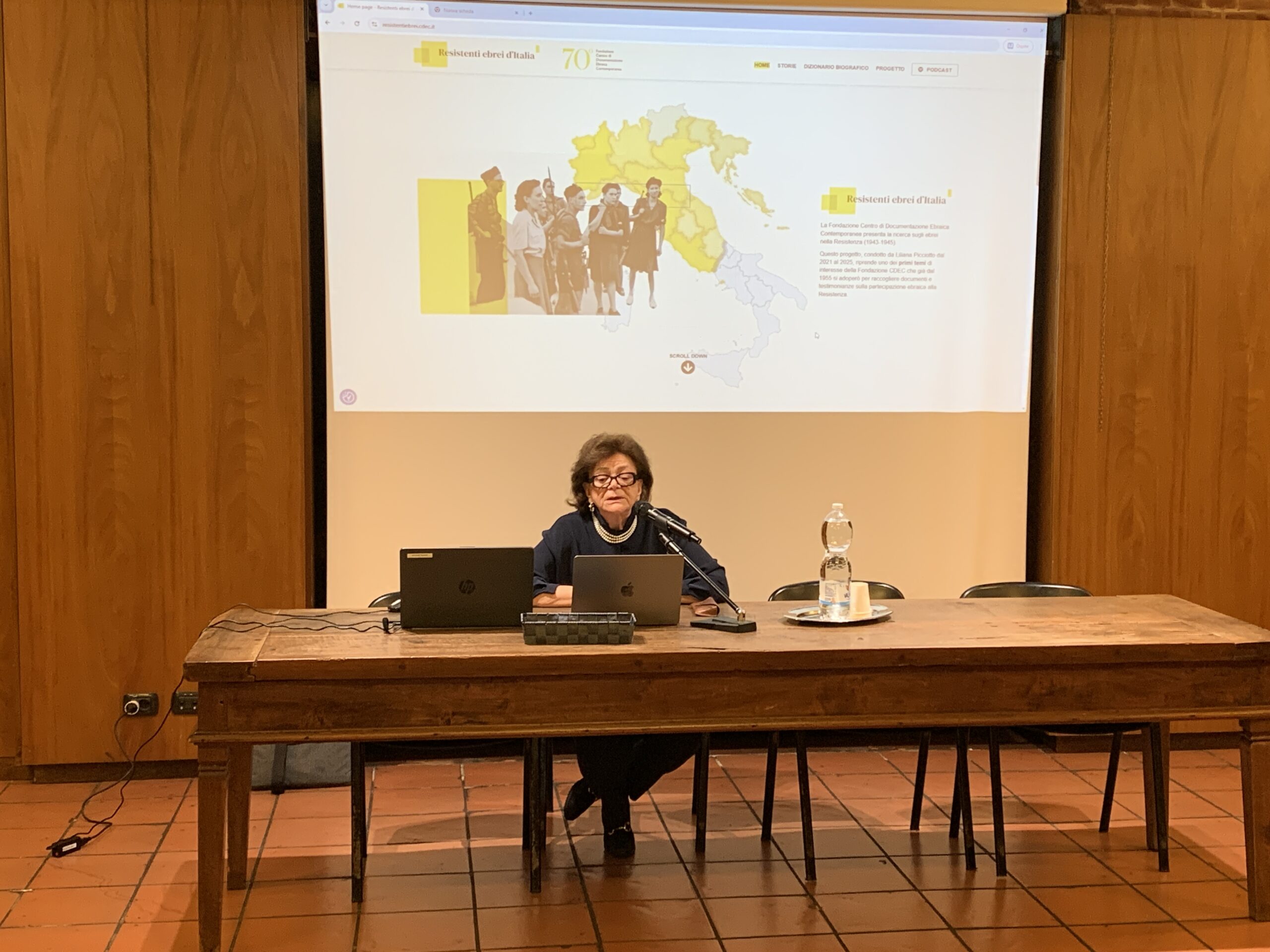
Our community celebrated Liberation Day last Sunday with two events: a presentation by author Liliana Picciotto of her research and database on Italian Jewish resistance fighters, and a performance by singer Carlo Pestelli, a researcher of Resistance songs and author of an interesting book published a few years ago on the history of Bella Ciao (Bella Ciao. The Song of Freedom, add, Turin 2016).
Two different yet complementary moments, both of which filled the hall of the Social Center.
Liliana Picciotto explained the motivations and methods of her research, which led to the creation of a database that will soon be published as a book (Einaudi), containing the 909 names of Jewish resistance fighters known to us to date and their highly varied stories. Many were from Piedmont, some of whom were mentioned in the presentation.
The database can be found at resistentiebrei.cdec.it
The Resistance, Picciotto concluded, was the necessary place of reconciliation for the Jews with a homeland that had proven to be a stepmother, the rebuilding of a pact that some today seem to be calling into question. Precisely for this reason, today more than ever, it is important to remember Jewish participation in the Resistance, too often unrecognized or underestimated.
Carlo Pestelli, a very talented and much applauded performer, retraced the history of the Resistance in chronological order, from the anarchist struggles to the postwar period, through many songs, some more well-known than others, introduced by brief explanations. Finally, Oltre il ponte, written by Italo Calvino and set to music by the Turin Jew Sergio Liberovici, could not be missed.
By Anna Segre