18:25
18:25 19:33
19:33 Noach - Gen. 6-9/11-32


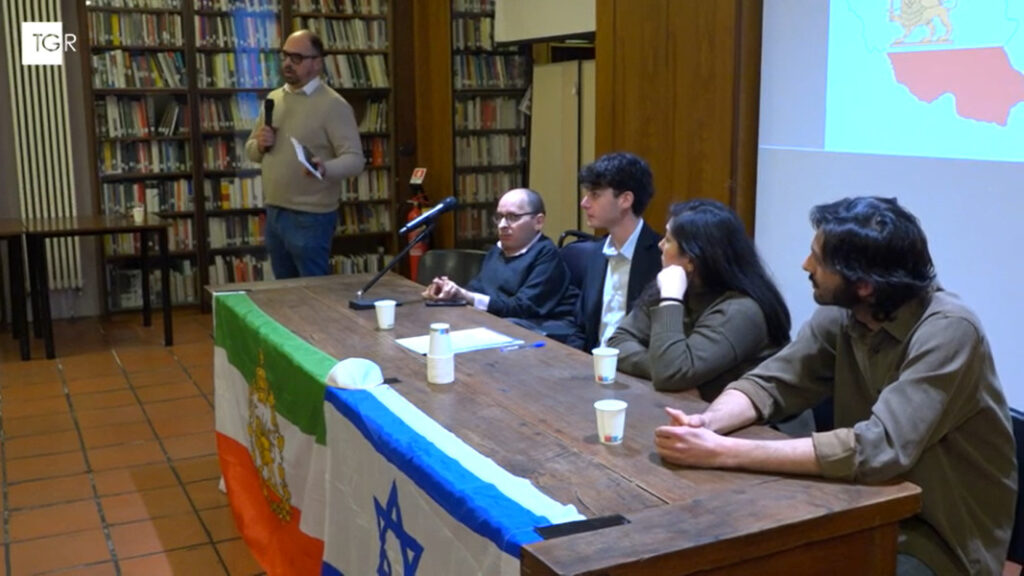
On Sunday, February 22nd, in the late afternoon, the Community hosted a meeting entitled “Iran and Israel: Rejecting Religious Fanaticism for a Shared Future of Peace and Hope.” An ambitious title, promising dialogue and complexity, and judging by the large and attentive turnout, it responded to a real need for listening and in-depth analysis.
Maintaining the discussion was Mattia Terracina, supported by journalist and expert Gabriele Segre. Alongside them, Iranian and Israeli voices offered different perspectives on two geopolitical contexts often described in a rigid and simplified manner.
Particularly powerful was the testimony of young Iranian dissidents, Shayan Gharesavari, who has lived in Italy since 2012 and graduated in Architecture and is committed to disseminating Iranian culture and the conditions of its people under the theocratic dictatorship, and Maryan Ismail, active in the Women, Life, Freedom movement. Their presentations brought to the room the concrete weight of personal and family experiences marked by the regime’s repression. Indeed, we are accustomed to analyses of Iran that are often far removed from the real world; listening to those who still bear the wounds of that reality offered many in attendance a different, more immediate and less abstract interpretation, albeit with some questionable parallels to the political orientations with which we Italian Jews still find ourselves confronting today.
The positions expressed were at times particularly clear and charged with emotional tension; a sign, perhaps inevitable, of an involvement born of profound personal stories. This intensity, while not always easy to grasp in all its nuances, reflected the civil courage of those who choose to publicly speak out against a system that has affected their lives and those of their loved ones.
Yarden Matarti’s speech, which was different and complementary, offered a more conciliatory reading. In other contexts, the distance between the different sensibilities that emerged could have sparked a more bitter debate; instead, the evening stood out for the quality of mutual listening. This was perhaps the most significant outcome: people with widely divergent views on the Middle East and the meaning of political orientations shared the same space with respect, maintaining a shared vision of peace, freedom, and dignity for their peoples.
Central in this regard was the role of the young organizer, Mattia Terracina, who had the remarkable merit of giving voice even to positions dissonant from his own and those of the movement he represented. In times when public debate often tends to harden into opposing camps, the decision to open a genuine space for discussion represents an encouraging sign that can serve as an example for us.
Knowing that within our Community, generations are growing up who are still willing to grapple with sensitive issues, without sacrificing complexity, is a reason for confidence in the future. Evenings like this don’t resolve the world’s conflicts, nor was that their goal, but they help build something equally valuable: the habit of dialogue.
And it is precisely from here, perhaps, that all shared hope can begin.
Ruben Piperno