18:25
18:25 19:33
19:33 Noach - Gen. 6-9/11-32


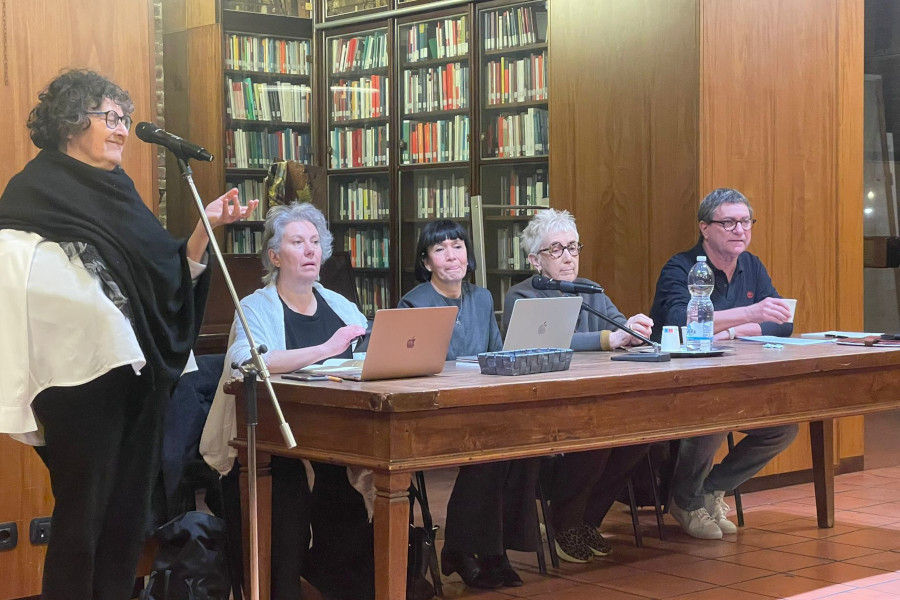
Yesterday, March 9th, at 9:00 p.m., a public meeting entitled “The Slap of Neofeminism to Israeli and Iranian Women” was held at the Social Center of the Jewish Community of Turin. The meeting was promoted by the Community together with the Circolo Liberalsocialista Carlo Rosselli, ADEI-WIZO, and the Camis De Fonseca Association.
The meeting, held on International Women’s Day 2026—and exactly one week after Purim, which commemorates the story of a Persian woman who was certainly not free but paradoxically more autonomous and empowered than her compatriots 2,500 years later—is a testament to the activities our Community has been carrying out since November 2023, when it launched an appeal with the UCEI to call on feminist movements to publicly condemn the rapes perpetrated on October 7, 2023, and subsequently on the hostages.
The meeting, moderated by Tiziana Allegra, entrepreneur and manager, arose from a question that pervades public debate today: is contemporary feminism still capable of defending all women?
In recent years, a current of thought, often referred to as neofeminism or intersectional feminism, has emerged that interprets discrimination through multiple identity categories—gender, ethnicity, sexual orientation, and cultural background. However, according to several observers and scholars, this approach sometimes risks creating a hierarchy of victims, in which not all women receive equal attention and solidarity.
The case of Iranian women is emblematic. For years, they have been fighting against a theocratic regime that imposes compulsory veiling and drastically limits civil and personal rights. The “Woman, Life, Freedom” movement, born after the death of Mahsa Amini, has highlighted the strength and courage of a generation of women demanding freedom and dignity. Yet this movement has not aroused the empathy among Western feminists that one might expect.
Similarly, the violence suffered by Israeli women during the terrorist attack of October 7 has raised profound questions about the silence or timidity of part of the international feminist movement in acknowledging the gender-based violence dimension of those events.
It is precisely from this tension that the provocative title of the meeting arises: a symbolic “slap,” which evokes the idea of a lack of recognition and a solidarity that is not always universal.
The participation of four different organizations in the evening ensured a large and diverse audience, as did the perspectives expressed in the speakers and the very approaches to the topic: from the presentation by Tullio Monti, President of the Circolo Liberalsocialista Carlo Rosselli, on the origins and limits of multiculturalism and neofeminism, to the reflections of Lucetta Scaraffia—a historian and essayist, long engaged in the debate on women’s rights and the relationship between feminism and religion—on the incredible and shameful reticence in the UN report on the rapes of October 7th; and the more general approach by Monica Lanfranco—a journalist and feminist, editor of the magazine Marea—on dialogue as an antidote to war. Inevitably, the topic, inextricably linked to many others, led the debate in various directions, from the history of the feminist movement to the current war against Iran and whether or not it is the right path to overthrow the regime.
What can we do to defend the rights and freedoms of all women, wherever they live, whatever their nationality, and whatever their religion? How can we ensure that the violence suffered by women elicits the same empathy and does not merit any justification, indifference, or indulgence? This is a question that cannot be answered in a single evening and will haunt us for a long time to come.
by Sara Levi Sacerdotti and Anna Segre