18:25
18:25 19:33
19:33 Noach - Gen. 6-9/11-32


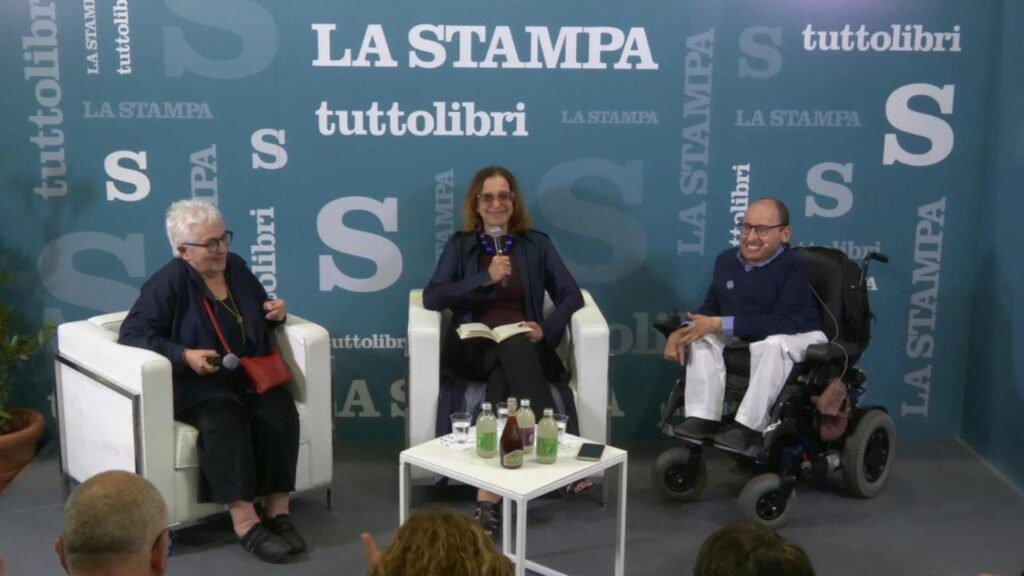
The recently concluded Book Fair featured, among many interesting events, a brief conversation between two people who, for different reasons (origin or membership in the Community), can be described as “Turin Jews”: Anna Foa and Gabriele Segre. The meeting took place last Sunday at La Stampa stand, moderated by Francesca Sforza.
Personally, I found it a bit jarring how, from the very first question, the moderator dismissed all concerns about rising anti-Semitism, hastily declaring that any criticism of the current Israeli government is now defined as anti-Semitism. Anna Foa, however, admitted that anti-Semitism exists and is a very serious problem, adding that precisely for this reason it should not be confused with what it is not; however, there was no time to clarify with concrete examples where, in her opinion, that line should be drawn—for example, whether or not one can call it anti-Semitism when one questions not the current Israeli government but the very existence of Israel.
I found some of Gabriele Segre’s considerations truly insightful and illuminating. In a few words, he highlighted critical issues that are too often underestimated or ignored: the importance of also considering the traumas that individuals and populations have suffered and the harmfulness of inappropriately evoking them; the danger of exploitation (the most dangerous thing to do if you want peace, he stated, is to make conflict a symbol of something else); the need to confront the present without looking to a past that cannot return.
The discussion focused more on Israel and Israelis than on us diaspora Jews. The brief meeting didn’t have time to discuss the perception of anti-Semitism in our communities, and it wouldn’t have been the right place. It’s still a disconcerting phenomenon. Why do some of our members and supporters see anti-Semitism as a very serious problem, while others seem to ignore it entirely? Why are there such striking differences (much more pronounced than what emerged in the polite exchange between Anna Foa and Gabriele Segre) even among people with very similar opinions on Israel? Does it depend on different lived experiences? On the different groups and environments we frequent? On the bubbles in which each of us sometimes withdraws, even unconsciously?
It would be wonderful to host a meeting like last Sunday’s at the Salone in our community. It would be wonderful, in general, to have a moment of genuine dialogue, offering the opportunity to compare different perceptions of anti-Semitism and the differing opinions on the appropriate means to combat it. Next Monday evening, May 25th, the discussion on bills to combat anti-Semitism could be an excellent opportunity, provided there is also the opportunity to raise doubts and objections.
Anna Segre