 19:04
19:04 20:11
20:11 SUKKOT, primo giorno - Lev. 22-26/23-44, Num. 29-12/29-16


The 15th of the Hebrew month of Av, which begins this evening, is the feast of love according to Jewish tradition. It’s surprising to find an ancient date, dating back to the time of the Mishnah, that celebrates love without recalling any war or attempt by other peoples to annihilate us, physically or spiritually. No less surprising is the date’s proximity to the recently concluded period of intense mourning during which we commemorated the destruction of our temples, caused, for the second time, by gratuitous hatred between people.
Tu Be-Av (the 15th of Av) is mentioned for the first time in the Mishnah, which states: “There were no happier days for Israel than the fifteenth of Av and the Day of Atonement (Yom Kippur).” (Tractate Ta’anit, chapter 4).
The same passage describes how young women in Jerusalem would go out dancing among the vineyards wearing borrowed white dresses, with the aim of finding a potential husband. Why did they wear borrowed clothes? The reason was simple: “so as not to embarrass those who did not own them.” In other words, they wanted to avoid humiliating those who did not have the means to buy new clothes, thus creating a climate of equality and a network of solidarity among all young women. This is a beautiful and original response to the gratuitous hatred that characterized the preceding period, insinuating and making us understand that one person’s joy does not detract from another’s joy, and that contributing to another’s success can only help ourselves. As they danced, the Mishnah tells us, the girls sang: “Young man, lift up your eyes and consider whom you choose. Do not look at beauty, but at family.” As it is written: “Charm is deceitful, and beauty is fleeting; a woman who fears the Lord is worthy of praise.” (Proverbs 31:30)
This short text teaches us the difference between romance and lasting love, but also the practicality of the women of Israel: we dance, yes, we are moved, we fall in love… But we also see the next day. Beauty is a virtue, but so is belonging to a family rich in values and importance. The beauty we orient ourselves toward is not only that of external appearance, but also the beauty of actions, of the alliance built together, of the fruits of one’s labors. True love is recognized and cultivated through what two people build together: their values, their mutual commitment, and the works that shape their shared life. With a surprising sense of humor, the text continues: “And if there is neither beauty nor belonging to a prominent family, take us anyway, and this will be considered an act of kindness toward Heaven.” (Taanit 31). Ultimately, they say, what matters is the willingness to build a life together, to share a life plan, to take risks.
The Babylonian Talmud recalls several happy historical events that, according to tradition, occurred on the 15th of Av (Tu Be-Av). Among the most significant is the revocation of the divine decree that had condemned the generation of the Exodus to die in the desert because they had sinned by showing fear and hesitation in entering the land of Israel. We also find the renewed permission for members of the tribe of Benjamin to intermarry with other tribes, ending the prohibition imposed after the tragic episode of a civil war between the tribes of Israel. The Book of Judges recounts that, during an annual festival celebrated in the town of Shiloh, where young women went out to dance among the vineyards, the girls were “kidnapped” by men of the tribe of Benjamin, thus allowing the tribe to survive.
Tu Be-Av was also an important holiday in the pre-State of Israel period in the Yishuv, the Jewish community settled in the Land of Israel before the founding of the state. In some settlements, probably inspired by agricultural references in ancient sources, it was decided to celebrate this holiday also as a festival of grape harvest and wine, while in other places it was traditional to gather for folk dances. The story “The Fifteenth Day of Av in the Land of Israel,” published in 1903 by Ze’ev Ya’avetz, describes Tu Be-Av celebrations in the agricultural settlement of Rishon LeZion, where the holiday had a special significance: the city had in fact been founded on that very day. In 1912, the newspaper HaTzvi, edited by Eliezer Ben-Yehuda, published a call for Tu Be-Av to be proclaimed a national holiday. Furthermore, during the 1920s, youth rallies were organized in honor of this joyous occasion. The connection between love, music, and dance continues today. From 1978 to 2011, the “Leil Ahavah” (“Night of Love”) festival was held annually on Tu Be-Av on the shores of Sea of Galilee (Kinneret), near Tzemach. It hosted some of Israel’s most prominent musicians and attracted visitors from across the country. Furthermore, since 2009, the women’s dance festival “Mecholalot BaKeramim” (“Dancers Among the Vineyards”) has been held annually on Tu Be-Av in the village of Shiloh. The event pays homage to the ancient tradition described in rabbinic sources and represents a moving and joyful way to celebrate love.
And finally, a survey: In 2019, the Jewish People Policy Institute (JPPI) decided to investigate which of the two holidays was more deeply felt by Israelis: Valentine’s Day or Tu Be-Av. The results were very clear: 10% of Israelis said they didn’t know what Valentine’s Day was, while only 1% didn’t know Tu Be-Av. The news underscores how, at least according to that survey, the traditional Jewish holiday of love continues to be perceived by Israelis as more significant than the holiday imported from the West.
Ruth Mussi
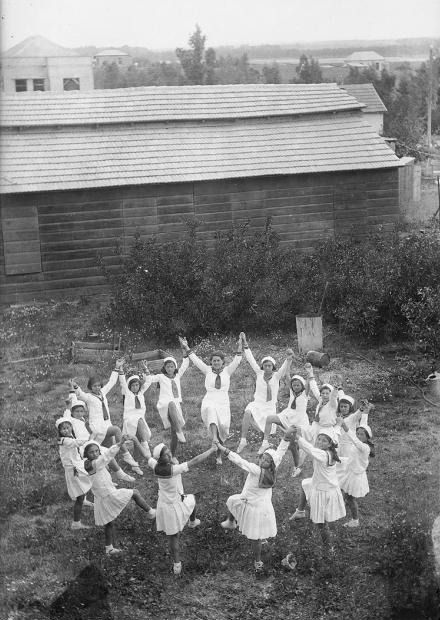
Picture: Girls dancing at Tu Be-Av in Hadera, early 20th century.*From the Archives of the Khan Museum in Hadera.Photograph: Sonia Kolodny – CC BY 2.5 license. Published on NLI.

