18:25
18:25 19:33
19:33 Noach - Gen. 6-9/11-32


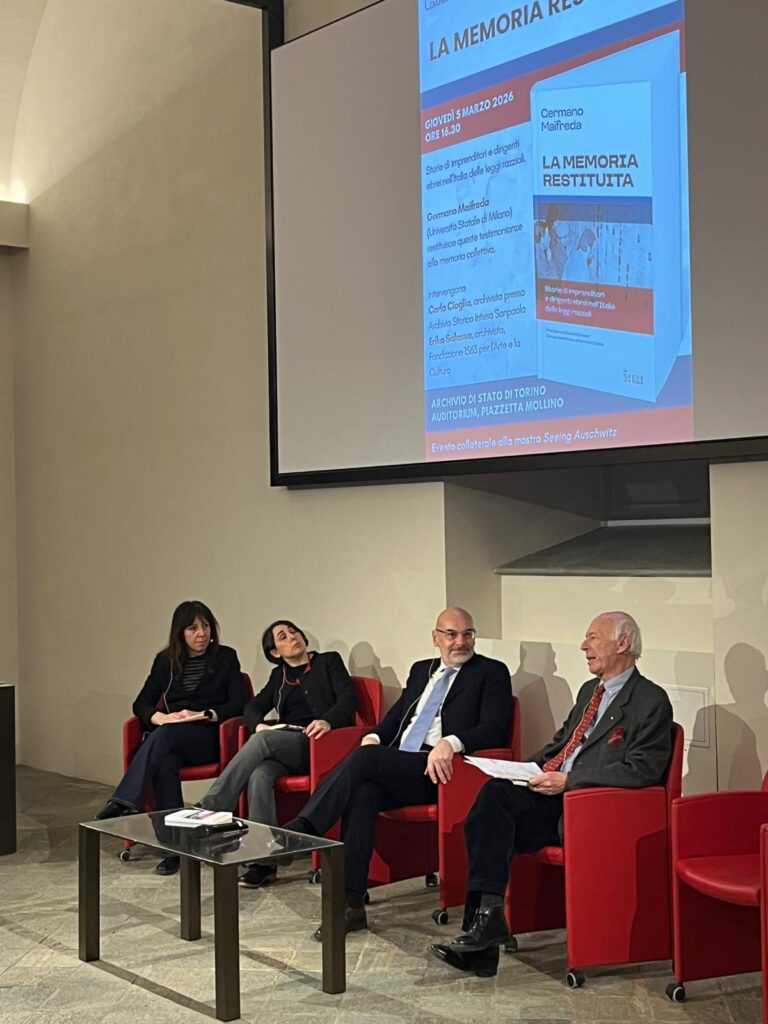
To understand, reflect, and attempt to delve deeper, and establish useful comparisons by broadening perspectives is the goal of the series of collateral events to the beautiful and moving exhibition Seeing Auschwitz, hosted until March 31st at the State Archives of Turin. The most recent of these events took place at the same venue on March 5th, bringing to the public’s attention a topic that may seem secondary, but which actually leads us to gauge the extent of the upheavals imposed not only on the Jewish minority but on Italian society as a whole by the anti-Semitic stance of the fascist regime: the impact of several prominent Jewish leaders and Jewish entrepreneurs in general on the “racial campaign” and the racist laws of 1938 and the following years. This is the central theme of the book “La memoria ritrovata. Storia di imprenditori e diretti ebrei nell’Italia delle leggi razziali” (“The Rediscovered Memory. A History of Jewish Entrepreneurs and Managers in the Italy of the Racial Laws” [Il Sole 24 Ore], 2026] by economic historian Germano Maifreda, professor at the University of Milan.
To assess the impact of this pernicious trend (which is inherent in totalitarian ideology), the author’s expertly drawn profile, along with appropriate historical and bibliographical references, prompted by Dario Disegni’s questions, suffices. On the one hand, the centuries of the modern era, in which underlying official anti-Judaism was circumvented and effectively defused by local, temporary, and personal measures (think of the recurring “conduct” or the role of “court Jews”) that favored sectors of the Jewish world active in trade and finance, to the benefit of the entire economic and social system. On the other hand—after the liberation from the ghettos, the recognition of civil and political rights, the patriotic sharing of the Great War, and the illusion of full Italianness—the end of liberal Italy, a climate of increasing imposition and control, Mussolini’s self-interested support for incipient Zionism to encourage Jewish emigration, the growing rejection of their presence and influence, up to the fatal blow of the racist laws that sanctioned the choice of state anti-Semitism. With this approach, every productive function and every positive development brought by Jewish entrepreneurship was lost, paving the way for the great tragedy of Italian Jews. It was then difficult to recover the economic role of several important figures in the postwar period, whose story Maifreda recounts extensively in the second part of his essay. As if completing the picture of isolation and progressive exclusion during the years of the racist laws, Carla Cioglia of the Intesa San Paolo Historical Archive and Erika Salassa, archivist at the 1563 Foundation for Art and Culture, finally outlined the ongoing historical research to reconstruct the experiences of the persecuted Jews, based on the extensive documentation then acquired by E.GE.L.I. (Ente Gestione e Liquidazione Immobiliare), the agency responsible for managing and, if necessary, selling assets seized from Italian Jews.
The only flaw in this interesting afternoon was the small audience attendance. It’s a real shame that these significant opportunities for analysis and understanding are not being adequately addressed.
David Sorani